
Axial flux motors offer a transformative alternative to traditional radial flux machines in electric vehicles. Key advantages include:
- Higher torque and power density
- Superior efficiency and thermal performance
- Compact, flat form factor ideal for modern EV packaging
- Lower magnetic material requirements
- Better integration with advanced EV architectures
While challenges remain, automotive manufacturers and component suppliers are increasingly turning to axial flux designs to meet stringent performance, weight, and efficiency goals.
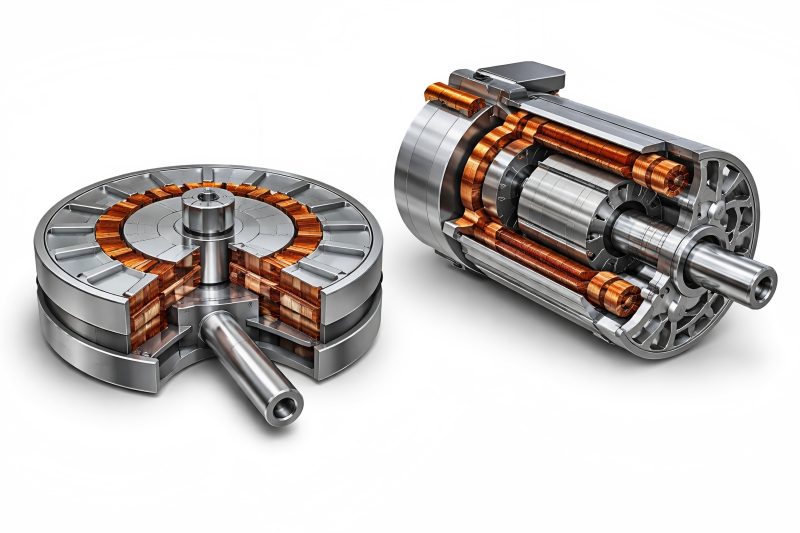
Motor Topologies: Axial Flux vs Radial Flux
What Is a Radial Flux Motor?
In a radial flux motor, magnetic flux flows radially — that is, from the center of the rotor outward or vice versa. Most conventional EV motors, like induction and PMSMs, are based on radial flux designs.
Key Features of Radial Flux Motors:
- Circular cylindrical geometry
- Flux path runs radially
- Wide industry adoption and manufacturing maturity
What Is an Axial Flux Motor?
An axial flux motor features magnetic flux that travels parallel to the motor’s axis (along the shaft direction). Its rotor and stator resemble stacked discs rather than cylinders.
Key Features of Axial Flux Motors:
- Disc-shaped geometry
- High torque density
- Short magnetic path length
Geometric and Magnetic Differences
| Feature | Radial Flux Motor | Axial Flux Motor |
| Flux Direction | Radial | Axial |
| Geometry | Cylindrical | Disc / Pancake |
| Magnetic Path Length | Longer | Shorter |
| EndStack Length | Longer | Shorter |
| Torque Density | Moderate | High |
| Packaging Flexibility | Limited | High |
| Cooling Surface Area | Smaller | Larger (disc surface) |
The geometry of AFMs gives them distinct electromagnetic and thermal characteristics compared with RFMs. These differences lead to multiple performance and efficiency outcomes that are particularly relevant for automotive applications.
Key Advantages of Axial Flux Motors in EVs
Higher Torque Density
In EVs, torque density (torque per unit volume or mass) is crucial. Higher torque density allows for smaller, lighter motors without sacrificing performance.
Axial flux motors are capable of generating much greater torque at low speeds due to:
- Larger effective air gap perimeter
- Better utilization of magnetic materials
- Increased rotor/stator interaction area
This results in more torque for the same size and weight compared to an equivalent radial flux motor.
Impact for EVs:
- Smaller motors reduce vehicle weight
- More compact packaging frees space for batteries or cargo
- Improved acceleration and driveability
Compact and Flat Form Factor
A unique advantage of axial flux motors is their “pancake” shape, which makes them exceptionally compact in axial length.
Benefits:
Allows different integration strategies such as:
- Hub motors in wheels
- Integration into drive axes or transmission housings
Enables lower center of gravity
Easier packaging in EV platforms, where space is at a premium
Typical Applications:
- In-wheel motors
- Integrated powertrain modules
- Aerospace and electric motorcycle applications
By contrast, radial flux motors are often bulkier for the same power rating.
Improved Efficiency Across Operating Range
Efficiency — the proportion of mechanical output to electrical input — plays a vital role in determining EV range and performance.
Why AFMs Are More Efficient:
- Reduced magnetic losses due to shorter flux path
- Better thermal management from greater surface area
- Lower copper losses at high current densities
Axial flux machines generally achieve higher peak and partial load efficiencies, which results in a greater proportion of the battery’s stored energy being converted into motion.
Extended Range: Higher efficiency leads to longer range per charge, enhancing consumer EV satisfaction.
Enhanced Thermal Management
Thermal performance affects motor longevity, power handling, and reliability.
Axial Flux Advantages:
- Disc geometry exposes more surface area for cooling
- Heat can be dissipated more uniformly
- Easy integration of liquid cooling at stator surfaces
Radial Flux Limitations:
- Heat must be conducted out through core iron, end windings, and frame
- Hot spots may appear within the winding pack
Better cooling allows axial flux motors to operate at higher continuous power levels without thermal derating.
Potential for Reduced Material Use
Permanent magnet materials (especially rare earth magnets) are expensive and subject to supply volatility.
Axial flux motors can reduce magnet usage due to:
- Efficient magnetic coupling
- Enhanced use of flux in the air gap
- Fewer magnets required for equivalent torque
This can lower cost and reduce dependency on critical raw materials — a growing concern in EV supply chains.
Performance and Packaging Comparison
Let’s compare three performance metrics across radial and axial flux motors commonly used in EVs.
| Metric | Radial Flux Motor | Axial Flux Motor | Notes |
| Torque Density | LowModerate | High | AFM often 20–50% higher torque density |
| Power Density | Moderate | High | Better flat packaging aids integration |
| Cooling Efficiency | Moderate | High | AFM disc design improves heat dissipation |
| Peak Efficiency | ~93–96% | ~95–98% | EV manufacturers target >95% |
| Magnet Usage | Higher | Lower | AFM efficiently uses flux from magnets |
| Packaging Flexibility | Limited | Excellent | Ideal for spaceconstrained EV designs |
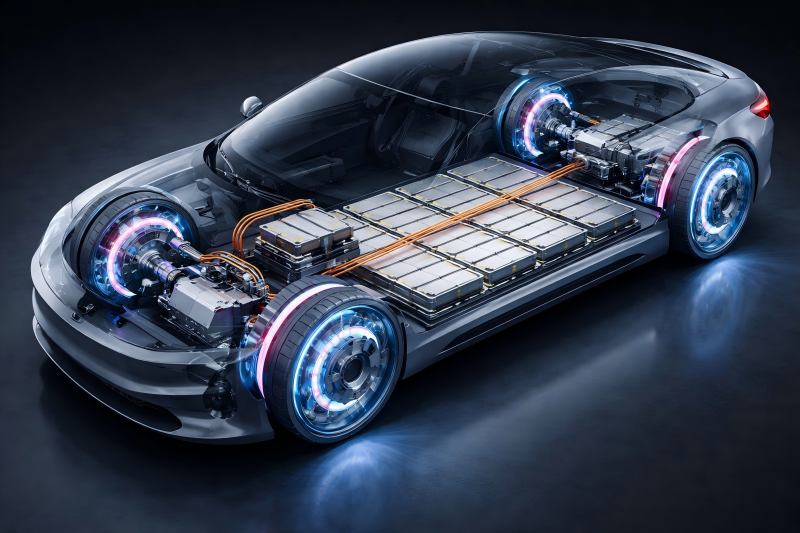
Real-World EV Use Cases
In-Wheel Motors
Axial flux motors are especially suitable for inwheel applications. Their flat design allows direct integration into wheel hubs, offering:
- Independent wheel torque control
- Reduced drivetrain complexity
- Regenerative braking at each wheel
Implementing radial flux motors in wheels is challenging due to their bulkier shape, making AFMs a more natural fit.
Integrated Powertrain Systems
The compact axial design allows motors to be integrated in unconventional spaces:
- Between battery modules
- In the vehicle’s floor pan
- Within gearboxes as part of a single module
This integration reduces mechanical losses, simplifies assembly, and enhances packaging efficiency.
Technical Comparison: Electromagnetic Characteristics
Below is a simplified comparison highlighting magnetic and electrical differences.
| Feature | Radial Flux Motor | Axial Flux Motor |
| Air Gap Length | Longer | Shorter |
| Magnetic Flux Path | Through stator core radially | Across flat disc section |
| Inductance Profile | Moderate | Lower due to shorter path |
| BackEMF Shape | Sinusoidal | Often improved for certain designs |
| Cogging Torque | Moderate | Can be lower with proper design |
These electromagnetic characteristics flow through into real performance benefits such as smooth torque delivery and responsive acceleration.
Challenges and Considerations
While axial flux motors offer compelling advantages, they are not without challenges:
Manufacturing Complexity
Disk-shaped stators and rotors can be more complex to manufacture and assemble than standard cylindrical designs.
Precision alignment is critical
Multi-disc assemblies can complicate winding and assembly processes
Bearing and Mechanical Load Demands
The axial forces in AFMs impose different loads on bearings compared with radial flux machines, requiring robust mechanical design.
Supply Chain Adaptation
Because radial flux motor manufacturing is wellestablished, adopting axial flux designs requires:
- New tooling
- Supplier qualification
- Design optimization expertise
However, many OEMs are investing in these transitions due to longterm performance benefits.
Future of Axial Flux in EVs
Industry trends indicate growing interest in axial flux motor adoption, particularly for:
- High-performance EVs
- Electric commercial vehicles
- In-wheel motor systems
- Aviation-grade electric propulsion
Research and development continue to refine materials, cooling approaches, and scalable manufacturing methods.