
Efficient airflow management is a cornerstone in industrial applications, HVAC systems, cleanrooms, data centers, and many other engineered environments. The fan market has evolved tremendously over the years, with more sophisticated solutions delivering higher performance, lower energy consumption, and superior control. Among the most significant advancements are Electronically Commutated (EC) backward-curved centrifugal fans—often touted as the new benchmark in airflow technology.
In contrast to traditional fan types—such as axial fans, forward-curved centrifugal fans, and standard induction-motor-driven backward-curved fans—EC backward-curved centrifugal fans provide several advantages. However, understanding where these advantages apply most, and when traditional fans still serve effectively, is crucial for designers, engineers, and procurement specialists.
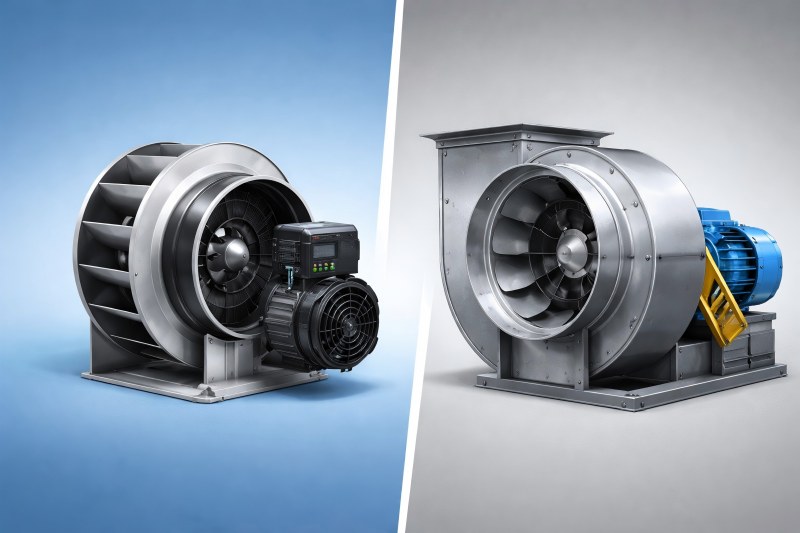
Fan Technology Overview
Before diving into direct comparisons, it’s useful to summarize the technologies under discussion.
Electronically Commutated (EC) Backward-Curved Centrifugal Fans
EC fans use a brushless DC motor with integrated electronics that combine the motor and variable speed drive into one compact assembly. The impeller in a backward curved configuration has blades that curve against the direction of wheel rotation.
Key characteristics:
- Combines motor and drive electronics in one unit
- Delivers high efficiency across various operating conditions
- Minimizes electrical losses for enhanced performance
- Offers precise control with variable speed capabilities
- Low noise compared to conventional motors
Traditional Fan Types
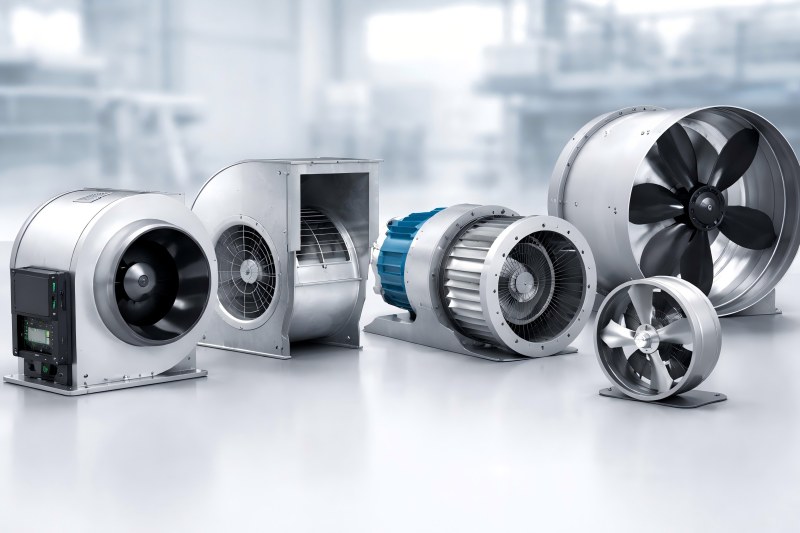
Traditional fans can be grouped into a few broad categories:
- Axial Fans – Air moves parallel to the axis, offering simplicity and cost-effectiveness, but limited pressure.
- Forward-Curved Centrifugal Fans – Impeller blades curve with rotation, making them ideal for low-pressure systems, such as HVAC.
- Backward-Curved Centrifugal Fans (Standard) – Blades curve against rotation, higher pressure capability, often driven by AC induction motors.
- Propeller Fans – A subtype of axial fan for low-pressure, high-volume applications (e.g., ventilation).
- Tubeaxial and Vaneaxial Fans – Axial fans with duct adapters for HVAC air movement.
Fundamental Performance and Efficiency Comparison
Performance and efficiency are critical when selecting a fan. They determine energy consumption, space requirements, and utility cost over the lifecycle.
Aerodynamic Performance
Backward-curved centrifugal fans generate higher static pressures, making them ideal for ducted systems with significant airflow resistance.
Below provides a concise comparison of various fan types in terms of static pressure capability, airflow range, and typical applications.
Performance Comparison of Fan Types
| Feature / Metric | EC Backward Curved Centrifugal | Standard Backward Curved Centrifugal | Forward Curved Centrifugal | Axial / Propeller Fans |
| Static Pressure Capability | High | High | Moderate | Low |
| Airflow Range | Moderate to High | Moderate to High | Moderate | High |
| Efficiency | Very High | Moderate | Low to Moderate | Moderate |
| Energy Control / Variable Speed | Excellent (integrated) | Good (external VFD) | Fair | Good (external VFD) |
| Noise Levels | Low | Moderate | Moderate to High | High |
| Typical Applications | HVAC, Data Centers, Cleanrooms, Industrial | HVAC, Industrial | HVAC, Low-Pressure Duct Systems | Ventilation, Cooling |
| Cost | Higher upfront | Moderate | Lower | Lowest |
Efficiency and Energy Use
EC backward-curved fans utilize permanent magnets and integrated drive electronics which greatly reduce electrical losses common in induction motors. This translates to up to 50%+ savings in energy use compared to traditional AC motor fans in variable load applications.
Traditional fans typically use AC induction motors. When paired with Variable Frequency Drives (VFDs), they can achieve some level of speed control but still suffer from additional conversion losses and control limitations.
System Control and Integration
One of the key advantages of EC fans is their integrated control logic, which is designed to seamlessly connect with:
- Analog signals (0-10V, 4-20mA)
- Digital communication (Modbus, BACnet)
- Feedback sensors (pressure, temperature, humidity)
This capability enables:
- Airflow optimization based on real-time demand
- Reduced energy waste during off-peak conditions
- Integration with building automation systems
By contrast, traditional fans require external drives and controllers to achieve similar control, increasing complexity and installation costs.
Durability, Maintenance, and Lifecycle Considerations
A fan’s total cost of ownership is heavily influenced by its reliability and maintenance needs.
Motor Durability
- EC Fans: Use brushless motors with electronic commutation. Less mechanical wear, lower heat generation, and typically longer life if operated within rated conditions.
- AC Induction Motor Fans: Simple and rugged but constitute wear in bearings and belts (if present). They often require periodic inspections and maintenance.
Bearing and Impeller Wear
Backward-curved centrifugal fans generally produce less turbulence at the inlet and discharge, reducing mechanical stress and extending operational life.
Maintenance Needs and Downtime
Maintenance activities like lubrication, belt replacement, and drive servicing are more frequent with traditional fan assemblies, especially in demanding environments.
EC fans simplify maintenance schedules due to fewer wearable components and integrated diagnostics that can alert operators to service needs.
Cost Analysis: Upfront vs. Lifecycle
Upfront Costs
- EC Backward-Curved Fans: Higher upfront cost due to integrated electronics and advanced motor technology.
- Traditional Fans: Lower initial cost, especially simple axial or forward-curved fans.
However, upfront costs do not reflect true value.
Operating Costs
EC fans run more efficiently and adaptively, resulting in:
- Lower electricity bills
- Reduced HVAC loads
- Lower peak demand charges
- Extended system life
For facilities operating multiple fans continuously (e.g., data centers, commercial HVAC), energy savings often pay back the premium on EC fans within 1–3 years.
Lifecycle Cost Comparison
Table 2 below outlines typical cost categories and how EC backward curved fans compare with traditional fans over a 10-year operational life.
Lifecycle Cost Comparison (10-year Estimated)
| Cost Category | EC Backward Curved Fan | Traditional Fan (Induction Motor Driven) |
| Initial Purchase | High | Low to Moderate |
| Installation & Commissioning | Moderate | Moderate |
| Energy Consumption | Lowest | High |
| Control System Costs | Integrated (lower) | External (higher) |
| Maintenance | Low | Moderate to High |
| Downtime & Service Interruptions | Low | Higher |
| Total 10-Year Cost | Competitive / Lower | Higher |
| Return on Investment (ROI) | Good | Moderate |
Noise and Environmental Impact
Noise and vibration are often overlooked factors but critical in comfort-sensitive environments like offices, hospitals, and residential HVAC.
Noise Levels
- EC Backward-Curved Fans: Quieter operation due to smoother motor control and optimized impeller design.
- Traditional Fans: Can generate more noise, especially at higher speeds or under fluctuating loads.
Lower noise also correlates with reduced vibration and structural load, which benefits equipment longevity.
Environmental Considerations
- Energy Efficiency: EC fans reduce energy use and carbon footprint.
- Material Use: EC fans are typically more compact, reducing material consumption.
Recyclability: Many components are recyclable, but electronic modules may complicate end-of-life recycling if not properly managed.
Practical Installation and Application Considerations
HVAC Systems
EC backward-curved centrifugal fans are particularly effective in modern HVAC units because:
- Airflow can be modulated automatically based on demand
- Static pressure compensation is excellent for ducted systems
- Lower sound levels improve occupant comfort
Traditional fans may still be suitable for simple ventilation or applications where control needs are minimal.
Industrial Process Applications
Industrial processes requiring precise airflow, such as drying systems, ovens, and manufacturing lines, benefit from:
- Stable pressure delivery
- Variable airflow control
- High efficiency at partial loads
Data Centers and Cleanrooms
These environments demand reliability and precise control. EC backward-curved fans deliver:
- Consistent airflow under varying thermal loads
- Lower energy draw (critical in high-density compute environments)
- Integration with environmental monitoring systems
- Traditional fans, even high-quality ones, often lag in control and efficiency.
When Traditional Fans Still Make Sense
Despite the advantages of EC backward-curved fans, traditional fans retain relevance in certain contexts.
Low Initial Budget Constraints
Project budgets with tight upfront capital may favor simpler traditional fans where advanced controls are not essential.
Simple Ventilation Needs
Applications focused on basic ventilation (e.g., warehouses, agricultural ventilation) might not benefit significantly from advanced flow control.
Retrofit Scenarios with Minimal Integration Needs
Older systems without modern control infrastructure may not justify the complexity of EC fan installation if the goal is simple replacement rather than system upgrade.
8. Future Trends and Technology Outlook
Fan technology continues evolving. Current trends include:
- Smart IoT integration – fans connected via networks for real-time monitoring
- Predictive maintenance – sensors relay data to anticipate failures
- Advanced materials – composites, coatings to reduce weight and improve performance
- Higher efficiency standards – regulatory push for energy performance (e.g., IE5 equivalents)
EC fan technology aligns well with these trends, making it a future-ready solution compared to traditional counterparts.
Summary and Key Takeaways
EC backward-curved centrifugal fans represent a significant technological step forward in airflow management, combining high efficiency, precise control, low noise, and reduced lifecycle costs. When compared with traditional fan types, especially those driven by AC induction motors, the benefits are particularly notable in:
- Energy efficiency and control
- Lifecycle cost savings
- Integration with automation systems
- Operational flexibility
However, traditional fan types still have roles where simplicity, low initial cost, or basic performance is sufficient.
Conclusion: Choosing the Right Fan Type
Selecting the right fan technology depends on:
- Performance requirements – pressure, airflow, environmental conditions
- Control needs – demand response, automation
- Budget priorities – upfront vs. lifecycle cost
- Noise and comfort considerations
- Integration with existing systems
For most modern commercial and industrial applications, EC backward-curved centrifugal fans offer a compelling combination of performance, efficiency, and control. Traditional fans remain relevant for straightforward, low-pressure ventilation or cost-constrained projects.
A careful evaluation against the criteria above ensures the most effective and economical choice for your airflow system.