
Electrification is transforming sectors such as transportation, robotics, aerospace, and energy. Across all these sectors, one requirement remains constant: achieving higher performance while reducing weight, volume, and energy consumption.
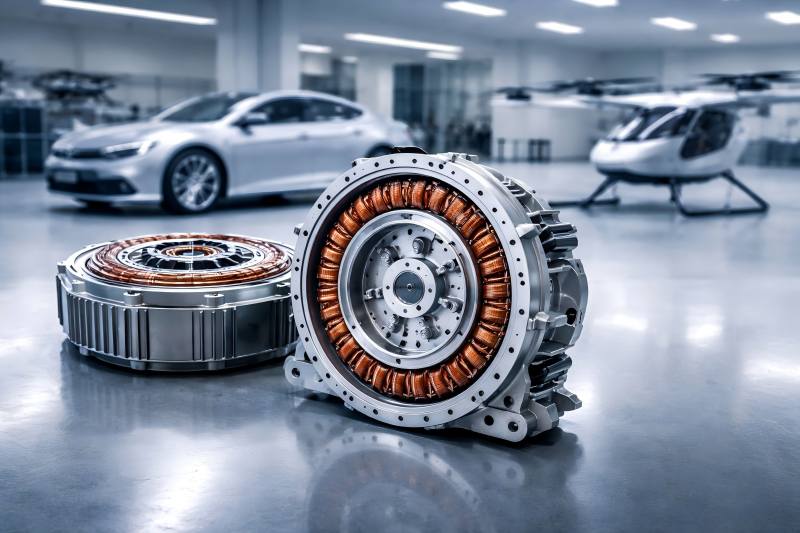
Unlike traditional radial motors, axial motors are designed to deliver high torque density in a flat, compact form factor. Their unique geometry allows engineers to rethink system integration, eliminate mechanical complexity, and reduce overall system mass.
Understanding Lightweight Electrification
Lightweight electrification refers to the integration of electric power and motion systems that minimize mass while maintaining or improving performance. Weight reduction is not merely a structural concern—it directly impacts efficiency, energy consumption, thermal behavior, and system lifespan.
In electric vehicles, lighter systems translate into longer driving range and improved acceleration. In aerospace and drones, reduced weight enables higher payloads and extended flight times. In robotics and automation, lightweight drives improve responsiveness, safety, and precision.
Motors play a central role in this equation. As one of the heaviest and most energy-intensive components in an electrified system, motor selection significantly influences overall system performance. Axial motors address many of the challenges faced by traditional motor architectures in lightweight applications.

Axial Motor Design Principles
Axial motors differ fundamentally from radial motors in magnetic flux orientation and structural layout. In a radial motor, magnetic flux extends outward from rotor to stator. In an axial motor, the magnetic flux travels parallel to the motor shaft, allowing torque to be generated across a large effective radius.
This design offers several inherent advantages:
- Short axial length, resulting in a flat, pancake-like structure
- Large active diameter, increasing torque leverage
- Efficient use of magnetic materials, improving power density
- Flexible rotor-stator configurations, including single-rotor/single-stator and multi-rotor designs
Because torque is proportional to force multiplied by radius, the larger effective radius of axial motors enables higher torque output without increasing motor mass. This feature is especially crucial in space- and weight-constrained applications.
Why Weight Matters in Electrified Systems
Weight reduction in electrified systems yields multiple cascading benefits:
Energy Efficiency
Reduced mass lowers inertia, requiring less energy for acceleration and braking.
Thermal Performance
Lightweight designs often simplify cooling paths, reducing thermal bottlenecks and improving reliability.
System Integration
Compact motors enable tighter integration with gearboxes, wheels, or driven components, eliminating couplings and reducing mechanical losses.
Cost and Sustainability
Less material usage lowers raw material costs and environmental impact, especially critical for high-volume electrification.
Axial motors directly contribute to all these areas by enabling high performance in a smaller, lighter package.
Torque Density and Power-to-Weight Advantage
One of the defining metrics in lightweight electrification is torque density—torque output per unit mass or volume. Axial motors consistently outperform many radial motor designs in this regard.
Axial Motor vs. Radial Motor – Key Performance Comparison
| Parameter | Axial Motor | Radial Motor |
| Torque Density | Very High | Moderate |
| Axial Length | Short | Long |
| Power-to-Weight Ratio | High | Medium |
| Cooling Efficiency | High (surface exposure) | Moderate |
| Integration Flexibility | Excellent | Limited |
| Mechanical Complexity | Low | Medium |
The flat geometry of axial motors allows them to generate higher torque at lower rotational speeds, often eliminating the need for reduction gears. Removing gearboxes not only reduces weight but also improves efficiency and system reliability.
Role of Axial Motors in Electric Mobility
Electric Vehicles (EVs)
In electric vehicles, weight is directly linked to driving range, battery size, and cost. Axial motors enable:
- Compact e-axle designs
- In-wheel motor integration
- Reduced drivetrain mass
- Higher efficiency at partial loads
By delivering high torque at low speeds, axial motors reduce reliance on multi-stage transmissions. This simplification leads to lighter drivetrains and improved vehicle packaging flexibility.
Micro-Mobility and Two-Wheelers
Electric scooters, bikes, and small motorcycles require efficient, compact motors. Axial motors are well-suited for hub-drive or mid-drive configurations where space constraints are severe.
Their thin profile allows designers to integrate motors without compromising aesthetics or ergonomics, while their high torque output supports smooth acceleration and hill-climbing capability.
Lightweight Electrification in Robotics and Automation
Robotic systems prioritize precision, responsiveness, and safety. Even small weight changes impact dynamics in collaborative robots and platforms.
Axial motors contribute to lightweight robotics by:
- Reducing joint mass, improving acceleration and deceleration
- Enabling direct-drive architectures, eliminating backlash
- Enhancing torque control and motion smoothness
- Improving energy efficiency during continuous operation
In humanoid robots, autonomous mobile robots, and exoskeletons, axial motors help achieve a balance between strength and agility. Their compact form allows actuators to be placed closer to joints, improving kinematic performance and reducing structural stress.
Aerospace, Drones, and Advanced Mobility
Weight sensitivity is most extreme in aerospace and unmanned aerial systems. In these applications, axial motors play a crucial role in enabling electrification where traditional motors are too heavy or inefficient.
Key benefits include:
- Higher thrust-to-weight ratios
- Improved thermal dissipation in low-pressure environments
- Compact integration into wings, propellers, or distributed propulsion systems
eVTOL aircraft depend on several lightweight motors spread across the airframe. Axial motors support this architecture by combining high power density with scalable modular designs.
Thermal Management and Cooling Advantages
Thermal performance is a limiting factor in high-power-density systems. Axial motors offer inherent cooling advantages due to their geometry:
- Large surface area exposed to ambient air
- Short heat conduction paths from windings to housing
- Compatibility with liquid or air cooling systems
Efficient thermal management allows axial motors to operate at higher continuous power levels without increasing mass. This capability is essential for lightweight electrification, where oversized motors for thermal margin are not acceptable.
Materials and Manufacturing Considerations
Advances in materials science and manufacturing technologies have accelerated the adoption of axial motors. Lightweight electrification benefits from:
- High-energy-density permanent magnets
- Thin electrical steel laminations to reduce core losses
- Advanced composite housings
- Advanced manufacturing methods like laser cutting and robotic winding
Design Factors Supporting Lightweight Axial Motors
| Design Factor | Contribution to Lightweight Electrification |
| High-Grade Magnets | Increased torque without added mass |
| Thin Laminations | Reduced iron loss and heat generation |
| Direct-Drive Architecture | Eliminates gearbox weight |
| Modular Rotor-Stator Design | Scalable power without redesign |
| Integrated Cooling Channels | Maintains power density |
While manufacturing axial motors can be more complex than radial motors, ongoing improvements in automation and tooling are reducing cost barriers and improving consistency.
System-Level Impact of Axial Motors
The true value of axial motors in lightweight electrification lies at the system level rather than the component level. When integrated thoughtfully, they enable:
- Smaller batteries due to higher efficiency
- Reduced structural reinforcement due to lower mass
- Simplified mechanical layouts
- Improved reliability through fewer moving parts
These benefits compound across the entire system, making axial motors a strategic choice rather than a simple motor substitution.
Challenges and Limitations
Despite their advantages, axial motors are not universally ideal. Challenges include:
- Higher initial design complexity
- Specialized manufacturing requirements
- Sensitivity to air-gap tolerances
- Cost considerations for low-volume production
However, in applications where weight and efficiency are critical, these challenges are often outweighed by performance gains.
Future Outlook: Axial Motors and the Next Phase of Electrification
As electrification expands into new domains—such as aviation, space systems, wearable robotics, and advanced industrial automation—the demand for lightweight, high-performance motors will continue to grow.
Axial motors are expected to play an increasingly prominent role due to:
- Continued improvements in materials and cooling
- Greater standardization and scalability
- Integration with power electronics and control systems
- Alignment with sustainability and energy efficiency goals
In many next-generation electrified platforms, axial motors will not merely replace radial motors—they will enable entirely new architectures that were previously impractical.
Conclusion
Lightweight electrification is no longer an optional design goal; it is a defining requirement across modern engineering disciplines. Axial motors address this requirement by offering exceptional torque density, compact form factors, and system-level efficiency advantages.
By reducing weight, simplifying drivetrains, and improving thermal performance, axial motors empower designers to push the boundaries of what electrified systems can achieve. From electric vehicles and robotics to aerospace and advanced mobility, their role in lightweight electrification solutions is both transformative and enduring.
As technology continues to evolve, axial motors are poised to become a cornerstone of efficient, high-performance, and sustainable electrified systems worldwide.