
The non-self-starting nature of synchronous motors can be explained as follows:
- No initial torqueis produced at standstill
- Rotor cannot immediately synchronize with the stator’s rotating field
- Magnetic forces alternate and cancel out
- Rotor inertia prevents instant acceleration
- Stable operation requires matching speeds
To overcome this limitation, various starting methods such as damper windings and VFDs are used.
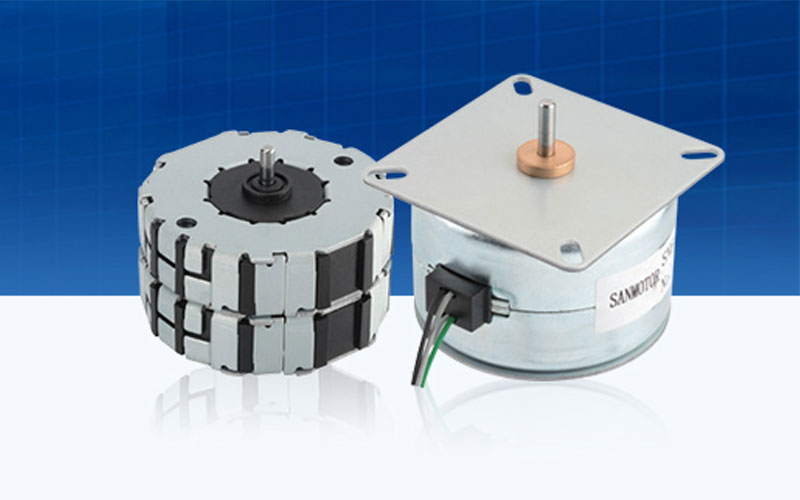
What Is a Synchronous Motor?
Unlike induction motors, synchronous motors have a rotor locked to the revolving magnetic field of the stator and run at a constant speed in step with the supply frequency.Important Features:
- Constant speed regardless of load
- High efficiency, especially in large-scale applications
- Capability to improve power factor
- Widely used in compressors, pumps, conveyors, and power plants
However, this precise synchronization is also the reason behind its inability to self-start.
Basics of Synchronous Motor Operation
To understand why a synchronous motor is not self-starting, we must first understand how it operates.
Stator
- Produces a rotating magnetic field when connected to an AC supply
- The speed of this rotating field depends on the supply frequency
Rotor
- Uses DC excitation or permanent magnet sources
- Establishes a stable magnetic field
Once in operation, the rotor synchronizes with the stator’s rotating magnetic field and turns at an identical speed.
The Core Reason: Lack of Starting Torque
The primary reason a synchronous motor is not self-starting lies in its inability to generate starting torque.
What Happens at Startup?
When power is first applied:
- The stator creates a rotating magnetic field
- The rotor is initially stationary
- The rotating magnetic field moves at a high speed
Because the rotor is not yet moving, it cannot immediately “lock” with the stator field. Instead, it experiences alternating forces—first in one direction, then in the opposite direction.
Result:
- The average torque over time becomes zero
- The rotor does not begin to rotate
This is the fundamental reason why synchronous motors cannot start on their own.
Magnetic Behavior at Standstill
When stationary, the rotor’s magnetic field is subjected to the stator’s rotating field, causing constantly changing magnetic effects.
Key Points:
- The stator field continuously changes direction relative to the stationary rotor
- The rotor experiences torque pulses rather than continuous torque
- These pulses cancel each other out
Analogy:
Imagine trying to push a swing that is moving too fast—your pushes will not align with its motion, resulting in no effective movement. Similarly, the rotor cannot “catch” the rotating magnetic field at startup.
Synchronization Requirement
Only when the rotor’s speed matches the stator’s rotating magnetic field can a synchronous motor function.
Critical Condition:
- Rotor must reach near synchronous speed before it can lock in
However:
- At startup, rotor speed = 0
- Stator field speed = high
This mismatch prevents synchronization.
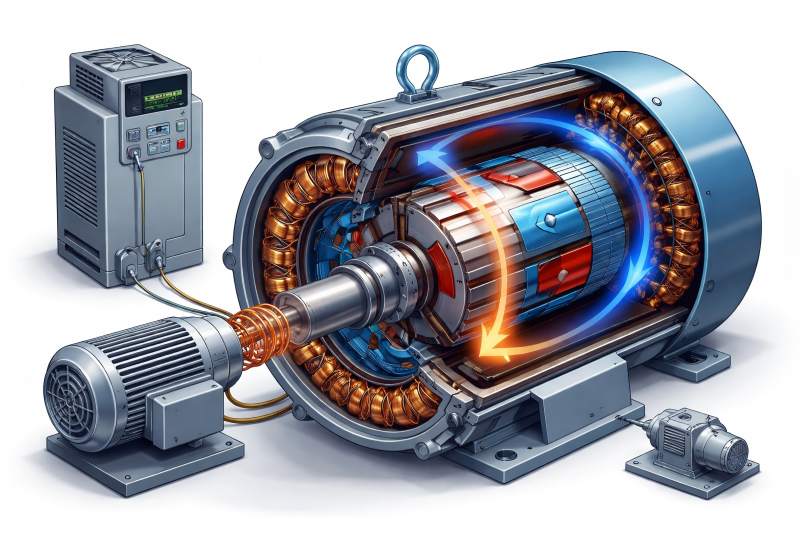
Comparison with Induction Motors
To better understand the limitation, it is helpful to compare synchronous motors with induction motors.
Synchronous Motor vs Induction Motor (Starting Behavior)
| Feature | Synchronous Motor | Induction Motor |
| Self-starting ability | No | Yes |
| Starting torque | Zero | High |
| Rotor current source | External DC or permanent magnet | Induced from stator |
| Speed during operation | Constant | Slightly less than synchronous |
| Slip | Zero | Non-zero |
| Starting complexity | High | Low |
Key Insight:
Induction motors generate torque through induced currents, allowing them to start automatically. Synchronous motors lack this mechanism at startup.
Role of Rotor Inertia
Another factor contributing to the non-self-starting nature is rotor inertia.
- The rotor has mass and resists sudden motion
- The stator field moves too quickly for the rotor to accelerate instantly
- Without gradual acceleration, synchronization cannot occur
Thus, the rotor remains stationary unless assisted.
Stability and Torque Direction
At a standstill, the torque produced in a synchronous motor is not only small but also unstable.
Characteristics:
- Torque direction changes rapidly
- No consistent rotational force is developed
- Rotor oscillates instead of rotating
This instability further prevents self-starting.
Practical Implications
Because synchronous motors cannot start on their own, they require external starting mechanisms.
Challenges:
- Additional equipment increases cost
- More complex control systems
- Requires careful synchronization process
Despite these challenges, synchronous motors are still widely used due to their efficiency and performance once running.
Methods to Start a Synchronous Motor
To overcome the starting problem, several methods are used in practice.
Common Starting Methods for Synchronous Motors
| Method | Description | Advantages | Disadvantages |
| Damper winding (amortisseur) | Rotor includes squirrel-cage bars for induction starting | Simple, widely used | Additional losses |
| External prime mover | Motor is brought to speed using another motor | Reliable | Expensive |
| Variable frequency drive (VFD) | Gradually increases frequency to match rotor speed | Smooth and efficient | High cost |
| Pony motor | Small auxiliary motor accelerates the rotor | Effective for large machines | Requires extra equipment |
| Reduced voltage starting | Applies lower voltage initially | Limits current | Limited torque |
Damper Winding: The Most Common Solution
One of the most widely used methods is the damper winding, also known as an amortisseur winding.
How It Works:
- Functions similarly to an induction motor during the starting phase
- Generates the initial torque required for rotation
- Brings the rotor speed up to near synchronous speed
Upon reaching a speed close to synchronization:
- DC excitation is applied
- Rotor locks into synchronization
Variable Frequency Drive (VFD) Approach
Modern industrial systems increasingly utilize variable frequency drives (VFDs).
Advantages:
- Smooth acceleration from zero speed
- Eliminates mechanical stress
- Improves energy efficiency
Process:
- Frequency starts low
- Gradually increases
- Rotor follows the changing magnetic field
This method effectively solves the self-starting problem.
Why Not Design It to Be Self-Starting?
A natural question arises: why not design synchronous motors to be self-starting?
Reasons:
Their design prioritizes constant speed and efficiency
Adding self-starting capability would:
- Increase complexity
- Reduce efficiency
- Increase cost
Instead, engineers prefer to use auxiliary methods.
Advantages Despite the Limitation
Even though synchronous motors are not self-starting, they offer several benefits:
Key Advantages:
- Precise speed control
- High efficiency at constant load
- Power factor correction capability
- Suitable for large industrial applications
These advantages often outweigh the starting limitation.
Industrial Applications
Synchronous motors are extensively used in various applications such as:
- Power plants
- Large compressors
- Industrial pumps
- Conveyor systems
- Paper and cement industries
In these applications, controlled startup is acceptable and often preferred.