
Single rotor and dual rotor axial flux motors represent two different design philosophies.
The single rotor design emphasizes simplicity, cost control, and easier production, making it suitable for many commercial and industrial applications. The dual rotor design focuses on maximizing torque density, improving force balance, and supporting higher performance requirements.
For applications requiring the highest power density within limited space, the dual rotor structure has clear advantages. However, for large-scale manufacturing where reliability, cost, and production consistency are equally important, a single rotor design may provide a better overall solution.
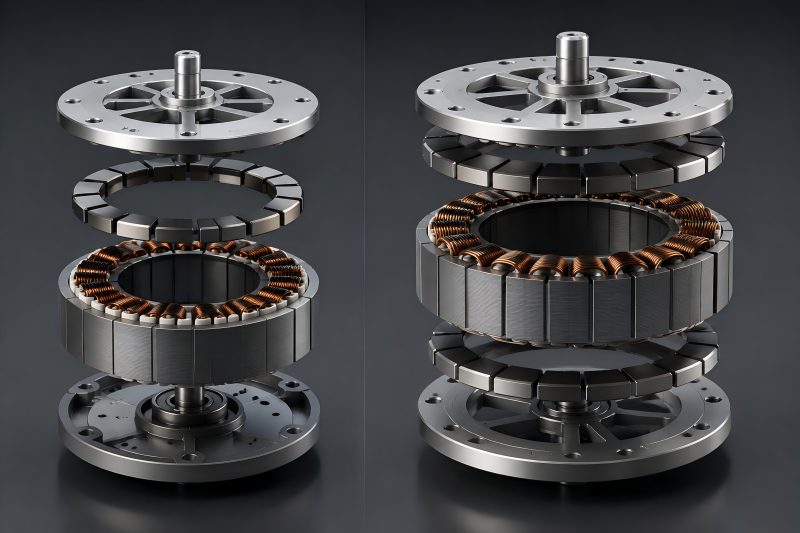
Basic Structure Difference Between Single Rotor and Dual Rotor Axial Flux Motors
The main difference between these two designs is the number and arrangement of rotors around the stator.
A single rotor axial flux motor features one rotor and one stator, with magnets on the rotor interacting with stator windings through a single air gap to produce torque.
A dual rotor axial flux motor uses two rotors positioned on both sides of the stator. The stator is located between the two rotors, creating two active air gaps. This structure allows magnetic forces to act from both sides, improving magnetic utilization and mechanical balance.
| Structure | Single Rotor Axial Flux Motor | Dual Rotor Axial Flux Motor |
| Rotor quantity | One rotor | Two rotors |
| Air gap | One active air gap | Two active air gaps |
| Stator position | One side of rotor | Between two rotors |
| Axial length | Compact | Slightly longer |
| Torque density | High | Generally higher |
| Manufacturing complexity | Lower | Higher |
| Cost | More economical | Higher |
The single rotor structure focuses on simplicity and cost efficiency, while the dual rotor structure focuses on maximizing performance within limited space.
Performance Comparison: Torque Density and Power Density
One of the biggest reasons engineers choose axial flux motors is their ability to achieve high torque density. The flat and wide magnetic path allows more active material to participate in torque generation.
A dual rotor design naturally has an advantage because the stator interacts with two magnetic fields. The electromagnetic force is distributed on both sides of the stator, allowing better utilization of copper and permanent magnets.
| Performance Factor | Single Rotor Design | Dual Rotor Design |
| Torque output | High | Very high |
| Power density | High | Higher |
| Magnetic utilization | Good | Excellent |
| Rotor force balance | Moderate | Better |
| Suitable applications | General compact systems | High-performance systems |
However, higher performance does not always mean better overall value. In applications where motor size and weight requirements are moderate, the additional performance of a dual rotor design may not justify the increased manufacturing difficulty.
For example, a compact industrial actuator may already meet its requirements with a single rotor motor. Adding a second rotor could increase cost without creating meaningful system benefits.
Mechanical Balance and Air Gap Control
Proper air gap control significantly affects axial flux motor operating performance.
In a single rotor motor, the magnetic attraction force between the rotor and stator acts mainly in one direction. This creates an axial force that must be supported by the bearing system and mechanical structure.
A dual rotor motor naturally balances these forces because the two rotors pull the stator from opposite directions. This reduces axial magnetic imbalance and can improve mechanical stability.
| Mechanical Factor | Single Rotor | Dual Rotor |
| Axial force balance | Requires additional support | Naturally balanced |
| Bearing load | Higher consideration required | Reduced axial load influence |
| Assembly tolerance | Easier | More demanding |
| Air gap adjustment | Simpler | More critical |
Although dual rotor designs have better force balance, they require more precise assembly. The distance between both rotors must be controlled carefully because uneven air gaps can reduce efficiency and create vibration.
Therefore, dual rotor motors offer better mechanical behavior, but only when manufacturing accuracy is well controlled.
Thermal Management Considerations
Heat management is another important difference between the two designs.
In a single rotor motor, heat generated inside the stator has fewer cooling paths. The rotor side may provide limited heat transfer depending on the structure. For continuous high-load operation, thermal design becomes a key challenge.
A dual rotor motor exposes both sides of the stator to rotating components, creating more opportunities for heat transfer. Some designs also use the rotor structure as part of the cooling solution.
| Thermal Factor | Single Rotor | Dual Rotor |
| Stator cooling surface | Limited | Larger effective area |
| Continuous power capability | Moderate to high | High |
| Thermal design difficulty | Lower | Higher |
| High-load operation | Depends strongly on cooling | More suitable |
However, the cooling advantage of dual rotor motors depends on the actual design. Simply adding another rotor does not automatically solve thermal problems. Cooling channels, housing design, material selection, and operating conditions still determine the final temperature performance.
Manufacturing Difficulty and Cost Comparison
From a manufacturing perspective, single rotor motors are easier to produce.
The stator assembly, rotor assembly, magnet placement, and final alignment process are relatively straightforward. Fewer components also mean fewer potential sources of production variation.
Dual rotor motors require tighter control over:
- Rotor parallelism
- Air gap uniformity
- Magnet positioning
- Stator alignment
- Assembly fixtures
These additional requirements increase production complexity.
| Manufacturing Aspect | Single Rotor | Dual Rotor |
| Number of components | Fewer | More |
| Assembly process | Simpler | More complex |
| Tooling requirements | Lower | Higher |
| Production yield control | Easier | More demanding |
| Manufacturing cost | Lower | Higher |
For prototype development, dual rotor designs can be attractive because they demonstrate excellent performance. However, when moving toward mass production, manufacturers must consider whether the performance improvement can offset the additional production investment.
Application Suitability Comparison
The best design depends heavily on the application.
Single rotor axial flux motors are often suitable for applications where compact size, reliability, and reasonable cost are priorities. Examples include industrial equipment, compact drive systems, robotics, and some electric mobility applications.
Dual rotor axial flux motors are more suitable for applications where maximum torque density and efficiency are critical. These include high-performance electric vehicles, aerospace systems, and advanced mobility platforms.
| Application Requirement | Recommended Design |
| Low manufacturing cost | Single rotor |
| Compact structure | Single rotor |
| Maximum torque density | Dual rotor |
| High continuous power | Dual rotor |
| Easier maintenance | Single rotor |
| Premium performance systems | Dual rotor |
Motor specifications alone should not determine the selection. System-level requirements such as available installation space, cooling conditions, production volume, and target cost should also be considered.
Which Design Is Better for Mass Production?
There is no universal answer to which axial flux motor design is better. A single rotor is easier to manufacture, easier to inspect, and easier to scale for large production volumes.
A dual rotor design provides higher performance potential but requires stronger manufacturing capability. Precision machining, accurate stacking, rotor balancing, and assembly control become more important.
For manufacturers producing motor cores, laminations, and stator assemblies, dual rotor motors also create additional requirements for dimensional accuracy. Small differences in stator thickness, flatness, or air gap control can directly influence motor efficiency and noise performance.