
The manufacturing process of an axial flux motor involves much more than assembling a compact motor structure. From core design and lamination processing to winding, rotor assembly, and final testing, every stage influences the final performance.
For manufacturers, the key is to achieve a balance between advanced motor design and practical production methods. A reliable axial flux motor requires not only strong electromagnetic performance but also accurate manufacturing control, stable assembly processes, and consistent quality inspection.
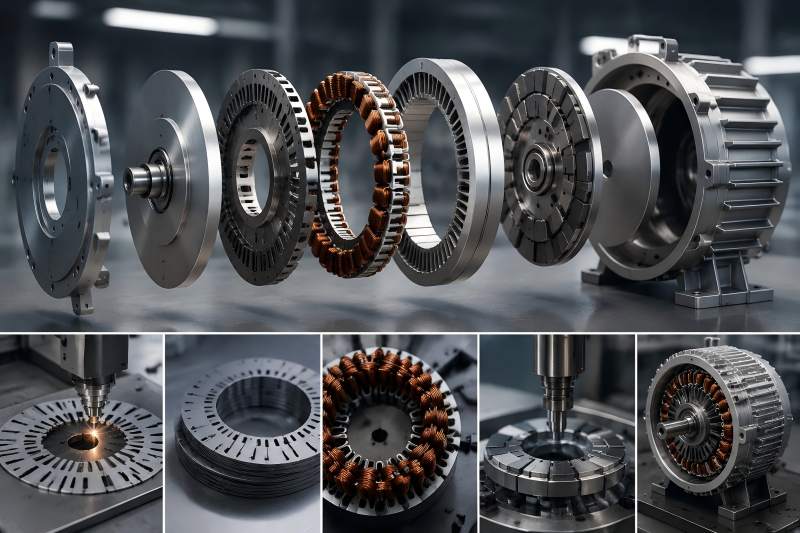
Axial Flux Motor Core Design and Engineering Preparation
The manufacturing process begins with a detailed design review. Before any tooling or production preparation, engineers need to define the motor’s electrical requirements, mechanical structure, and manufacturing route.
The axial flux motor core usually requires tighter control of magnetic paths because the axial structure has a shorter magnetic circuit and a larger influence from air gap variation. Small dimensional changes in the stator or rotor can directly affect torque output, efficiency, and vibration performance.
The main design factors include:
| Design Factor | Manufacturing Consideration |
| Motor diameter | Determines available torque area and core size |
| Air gap distance | Requires precise control to maintain magnetic performance |
| Stator structure | Affects lamination production and winding process |
| Rotor configuration | Influences magnet fixing and balance requirements |
| Cooling method | Determines housing and assembly design |
Compared with conventional motors, axial flux motors often have a thinner and more compact structure. This creates advantages in weight reduction but also increases manufacturing sensitivity. A design that performs well in simulation may still face challenges during mass production if tolerances, tooling, or assembly methods are not considered early.
For this reason, manufacturing feasibility should be included during the initial design stage. The best-performing design on paper is not always the easiest design to produce consistently.
Manufacturing of Axial Flux Motor Stator Core
The stator core is critical for axial flux motor performance and production. It provides the magnetic path and supports the winding system. However, its manufacturing method can be more complicated than traditional radial motor stators.
Depending on the motor structure, axial flux stators may use segmented laminations, ring-shaped laminations, or customized core structures. Electrical steel is usually selected according to efficiency requirements, operating frequency, and loss limitations.
The main manufacturing steps include:
- Electrical steel material preparation
- Lamination cutting or stamping
- Lamination stacking
- Insulation treatment
- Core fixing and inspection
For small-batch production or prototypes, laser cutting may be used because it provides flexibility for design changes. However, laser cutting can introduce different edge conditions compared with stamping, which may influence magnetic performance.
For volume production, stamping is usually preferred because it provides higher consistency and better production efficiency. The challenge is that axial flux motor laminations often have unique geometries, requiring accurate tooling design.
| Manufacturing Method | Advantages | Limitations |
| Laser cutting | Flexible for prototypes and small quantities | Higher processing cost for mass production |
| Stamping | High efficiency and repeatability | Requires dedicated tooling |
| Bonded core process | Reduces mechanical stress and improves shape flexibility | Needs controlled bonding conditions |
A key point in axial flux motor manufacturing is that the core should not only meet dimensional requirements but also maintain magnetic properties. Excessive mechanical stress, poor stacking accuracy, or improper joining methods can increase losses.
Axial Flux Motor Winding and Stator Assembly
After the stator core is prepared, the winding process becomes another critical manufacturing stage.
Because axial flux motors usually have a compact axial structure, available winding space can be limited. The winding design must consider copper filling factor, heat dissipation, insulation distance, and production accessibility.
Common winding considerations include:
| Winding Parameter | Impact on Motor Performance |
| Copper fill rate | Affects current capacity and torque output |
| Insulation thickness | Influences safety and thermal resistance |
| Winding arrangement | Determines electromagnetic performance |
| Connection method | Affects reliability and production efficiency |
The assembly process requires careful control because axial flux motors usually have smaller axial dimensions than traditional motors. Incorrect positioning of coils or uneven pressure during assembly can create unwanted air gap differences.
In production, automated winding equipment can improve consistency, but custom axial flux designs may still require specialized fixtures. The balance between automation and flexibility depends on production volume.
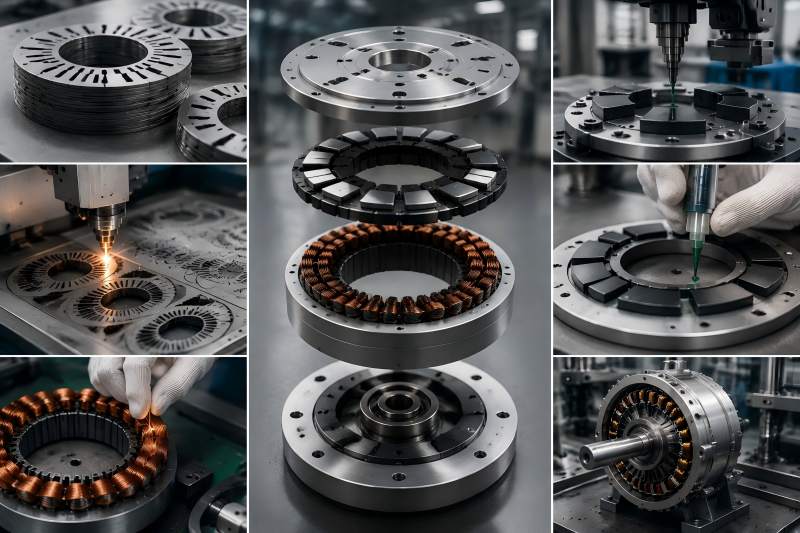
Rotor Manufacturing and Magnet Installation
The rotor is another major component that determines axial flux motor performance. Most axial flux motors use permanent magnets installed on the rotor surface to generate the required magnetic field.
The rotor manufacturing process generally includes:
- Rotor plate machining
- Magnet positioning
- Magnet bonding or mechanical fixing
- Rotor balancing
- Final inspection
Magnet positioning accuracy is especially important. Even small deviations between magnets can affect magnetic symmetry and create torque ripple or vibration.
Rotor balance is also critical because axial flux motors often operate at high speeds. Mass imbalance causes vibration, mechanical stress, and reduced durability.
| Rotor Manufacturing Step | Main Quality Concern |
| Plate machining | Flatness and dimensional accuracy |
| Magnet installation | Position consistency |
| Bonding process | Adhesion strength and durability |
| Balancing | Vibration control |
A practical consideration during manufacturing is the choice of magnet fixing method. Adhesive bonding offers a compact structure, while mechanical fixing may provide additional security for demanding applications. The selection depends on speed, temperature, and operating environment.
Precision Control During Motor Assembly
The final assembly stage determines whether individual components can work together as a complete motor.
Axial flux motors require precise rotor-stator air gap uniformity. Since magnetic forces act strongly across the axial direction, uneven gaps can significantly reduce performance.
Key assembly controls include:
| Assembly Item | Required Control |
| Rotor-stator alignment | Prevent uneven magnetic force |
| Air gap consistency | Maintain stable torque output |
| Shaft positioning | Reduce vibration |
| Fastener tightening | Avoid deformation |
During assembly, manufacturers should measure not only final motor performance but also intermediate components. For example, checking the stator core before winding and after assembly can help identify whether deformation occurs during processing.
This type of process control is especially important for custom motors because production issues are often caused by small accumulated errors rather than one obvious defect.
Testing and Quality Inspection of Axial Flux Motors
Before shipment, axial flux motors require electrical, mechanical, and performance testing.
Typical inspection items include:
| Test Item | Purpose |
| Insulation resistance test | Verify electrical safety |
| No-load operation test | Check basic motor behavior |
| Torque measurement | Confirm output capability |
| Temperature test | Evaluate thermal performance |
| Vibration test | Identify mechanical imbalance |
In mass production, testing should be integrated into each stage instead of limited to final inspection. Early detection reduces rework and helps maintain production consistency.
A complete quality system should connect design data, processing parameters, assembly records, and testing results. This allows manufacturers to trace performance differences between different production batches.
Challenges in Axial Flux Motor Manufacturing
Although axial flux motors provide excellent performance potential, their manufacturing process still faces several challenges.
| Challenge | Possible Manufacturing Solution |
| Complex core geometry | Develop suitable stamping or cutting processes |
| Tight air gap requirements | Improve machining and assembly accuracy |
| Heat accumulation | Optimize cooling structure |
| Limited production experience | Build process verification before mass production |
Producing one prototype is easy; maintaining consistency is the challenge. It is maintaining the same performance level during repeated production.
A prototype can tolerate manual adjustment, but commercial production requires stable processes, reliable tooling, and repeatable inspection methods.
From Prototype Development to Mass Production
The transition from prototype to mass production is one of the most important stages in axial flux motor manufacturing.
During prototype development, manufacturers usually focus on verifying electromagnetic performance. However, production requires additional attention to cost, processing efficiency, supplier capability, and quality consistency.
Important preparation steps include:
- Confirming production-intent materials
- Testing final manufacturing methods
- Verifying tooling accuracy
- Establishing inspection standards
- Evaluating long-term production stability
A well-planned axial flux motor must address manufacturing needs early. If production problems are discovered after design completion, modifying the structure can become expensive and time-consuming.