
Both AC drainage motors and DC drainage motors have their own advantages. AC drainage motors remain a reliable and economical choice for applications requiring stable operation and simple installation. DC drainage motors provide greater flexibility, efficiency, and control capability, making them increasingly suitable for modern intelligent equipment.
What Is a Drainage Motor?
A drainage motor is a compact electric motor designed to drive a drainage pump or water removal mechanism. Its main function is to convert electrical energy into mechanical power, allowing the pump to move condensate water, wastewater, or other liquids away from equipment.
Drainage motors are commonly found in:
- Air conditioning units
- Refrigeration systems
- Dehumidifiers
- Washing machines
- Industrial cooling equipment
- Medical equipment
- Commercial water management systems
Although the operating principle is similar to other electric motors, drainage motors usually require special characteristics such as:
- Stable operation under frequent starts and stops
- Compact size
- Low noise output
- Resistance to moisture and humidity
- Long service life under continuous operation
The choice between AC and DC technology mainly depends on the electrical design of the equipment and the required control performance.
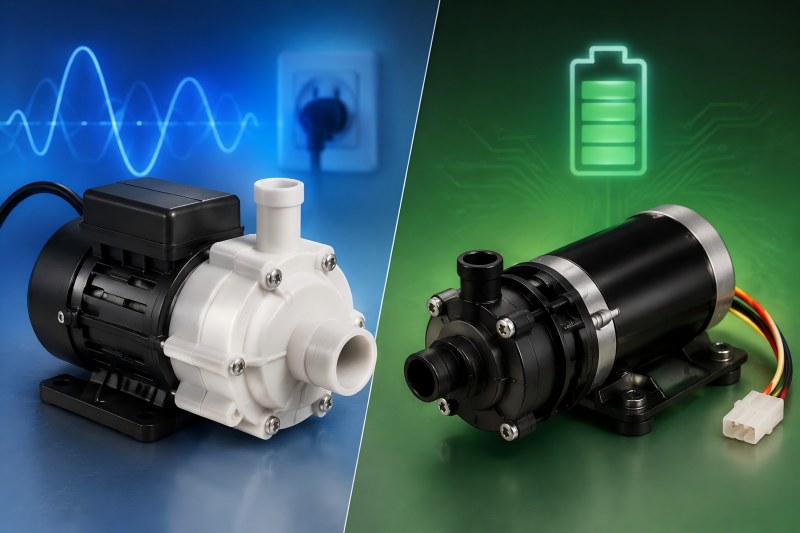
Basic Difference Between AC and DC Drainage Motors
The fundamental difference between AC and DC drainage motors is the type of electrical power they use.
An AC drainage motor uses alternating current with periodic directional changes. These motors are commonly connected directly to household or industrial AC power supplies, such as 110V, 220V, or 380V systems.
A DC drainage motor uses direct current flowing in a single direction. These motors typically work with lower-voltage DC power sources, such as 12V, 24V, or 48V systems, often supplied through adapters, batteries, or power conversion modules.
This difference influences their structure, efficiency, control method, and application range.
| Comparison | AC Drainage Motor | DC Drainage Motor |
| Power Supply | AC voltage directly | DC voltage through power supply |
| Common Voltage | 110V, 220V, 380V | 12V, 24V, 48V |
| Control Method | Usually fixed-speed operation | Easier speed and performance control |
| Structure | Simple and durable | More compact with electronic control |
| Efficiency | Good for stable operation | Generally higher efficiency at variable loads |
| Typical Use | Industrial and commercial equipment | Compact and intelligent equipment |
AC Drainage Motor: Advantages and Applications
Simple Structure and Reliable Operation
One of the biggest advantages of AC drainage motors is their simple mechanical structure.
Traditional AC motors usually contain fewer electronic components compared with modern DC motor systems. This makes them highly reliable, especially in applications where the motor only needs to perform a basic drainage function.
For example, in a commercial air conditioning system, the drainage motor may only need to start when condensate water reaches a certain level. A simple AC motor can complete this task efficiently without requiring complex control systems.
The reduced electronic complexity also means fewer potential failure points, which can be beneficial in harsh industrial environments.
Direct Connection to Standard Power Systems
Many buildings and factories already use AC power infrastructure. Because of this, AC drainage motors can often be installed without additional power conversion equipment.
This provides several benefits:
- Easier installation
- Lower initial equipment cost
- Reduced system complexity
- Convenient replacement during maintenance
For large commercial equipment manufacturers, AC motors remain a practical choice because they can be integrated into existing electrical designs.
Stable Performance for Continuous Operation
AC drainage motors are particularly suitable for applications requiring consistent operating speed.
For example, a drainage system that continuously removes condensate water from an industrial cooling unit usually does not need frequent speed adjustments. In this situation, a reliable AC motor can provide stable performance for long periods.
Typical AC drainage motors may operate continuously for thousands of hours when properly designed and maintained.
DC Drainage Motor: Advantages and Applications
Higher Efficiency in Variable Operating Conditions
DC drainage motors have become increasingly common because modern equipment often requires better energy management.
Unlike traditional fixed-speed AC motors, DC motors can adjust operating speed according to actual demand. When drainage requirements are low, the motor can operate at reduced speed, reducing unnecessary energy consumption.
For example, a smart dehumidifier may not need maximum drainage capacity all the time. A DC drainage motor can automatically adjust output based on water generation conditions, improving overall efficiency.
In applications with frequent load changes, DC motors can achieve noticeable energy savings compared with fixed-speed alternatives.
Compact Design and Flexible Installation
DC motors are generally easier to design into compact equipment because they can achieve high power density with smaller dimensions.
This makes them suitable for:
- Portable cooling equipment
- Compact refrigeration systems
- Household appliances
- Battery-powered devices
- Mobile equipment
As equipment manufacturers continue developing smaller and smarter products, the demand for compact DC drainage motors has increased.
Better Speed Control and Intelligent Functions
One major advantage of DC drainage motors is their compatibility with electronic control systems.
Through controllers or integrated circuits, DC motors can provide functions such as:
- Variable speed operation
- Soft start
- Overload protection
- Automatic adjustment
- Remote monitoring compatibility
These features are especially valuable in modern equipment where drainage performance needs to be optimized according to real-time conditions.
Performance Comparison: AC vs DC Drainage Motor
When comparing actual performance, neither AC nor DC drainage motors are universally better. Selection depends on specific application needs.
| Performance Factor | AC Drainage Motor | DC Drainage Motor |
| Energy Efficiency | Suitable for constant operation | Better for variable operation |
| Speed Adjustment | Limited | Excellent |
| Noise Control | Good | Usually better with optimized control |
| Maintenance | Simple structure | Requires electronic components |
| Initial Cost | Lower | Usually higher |
| System Integration | Easier with AC systems | Better for smart equipment |
Energy Consumption Comparison
Energy efficiency matters more as manufacturers seek lower operating costs. Assuming two drainage motors provide similar pumping capacity:
- An AC motor may operate continuously at a fixed speed.
- A DC motor can adjust speed based on drainage demand.
For a system running 10 hours per day, a DC motor that reduces average operating power by approximately 20%–30% could significantly reduce annual electricity consumption.
However, this advantage depends on operating conditions. If the motor always needs to run at full capacity, the energy difference may become smaller.
Therefore, selecting a DC motor only for efficiency reasons may not always provide the best economic result.
Cost Considerations
Several factors influence drainage motor selection, and cost remains a key consideration.
AC Drainage Motor Cost
AC motors usually have:
- Lower purchase cost
- Simple wiring requirements
- Easy replacement
- Mature manufacturing technology
For applications where the motor runs under stable conditions, AC solutions often provide excellent value.
DC Drainage Motor Cost
DC motors usually require:
- Additional control circuits
- Power conversion components
- More advanced electronic design
This increases initial investment.
However, the higher upfront cost may be justified when the equipment requires:
- Energy savings
- Variable operation
- Compact design
- Smart control features
The correct evaluation should consider the total lifecycle cost rather than only the purchase price.
Which Drainage Motor Should You Choose?
The choice between AC and DC drainage motors should be based on several practical factors.
Choose AC Drainage Motor When:
An AC drainage motor is usually suitable when:
- The equipment uses a standard AC power supply
- The motor operates at a fixed speed
- Reliability and simplicity are the priority
- Initial cost needs to be controlled
- The application requires continuous operation
Typical examples include industrial air conditioning systems, commercial refrigeration units, and large equipment.
Choose DC Drainage Motor When:
A DC drainage motor is usually a better choice when:
- Energy efficiency is important
- Variable speed control is required
- Space is limited
- The equipment uses intelligent control systems
- Low-voltage operation is preferred
Typical examples include portable cooling equipment, smart appliances, and compact environmental control systems.
Future Trend of Drainage Motor Technology
The drainage motor industry is moving toward higher efficiency, smaller size, and smarter control.
Several trends are influencing future designs:
Increased Adoption of Brushless DC Technology
BLDC motors deliver higher efficiency, longer life, and quieter performance.
- Longer service life
- Lower maintenance requirements
- Higher efficiency
- Reduced noise
Compared with traditional motors, BLDC solutions provide better performance for modern intelligent equipment.
Integration with Smart Control Systems
Future drainage systems will increasingly communicate with control platforms. Motors may automatically adjust operation according to:
- Water level
- Equipment load
- Operating environment
- Energy-saving targets
This trend is especially relevant for HVAC and industrial automation applications.
Greater Focus on Reliability in Harsh Environments
Drainage motors often work in humid environments where moisture resistance is critical. Future products will continue improving:
- Waterproof protection
- Corrosion resistance
- Thermal management
- Long-term stability
For traditional industrial drainage applications, AC motors continue to offer dependable performance. For compact, energy-efficient, and smart equipment, DC drainage motors provide more opportunities for optimization.