
Matching a synchronous motor with a gearbox is not only about connecting two mechanical parts together. The right combination must meet your required speed, torque, load type, duty cycle, installation space, efficiency target, and safety factor.
If the motor is too small, the system may fail to start, overheat, lose synchronism, or trip under load. If the gearbox is not selected correctly, it may suffer from high wear, vibration, backlash, oil leakage, or premature gear failure.
Synchronous Motor and Gearbox Matching
| Matching Factor | What to Check | Why It Matters |
| Output speed | Required machine speed | Determines gearbox reduction ratio |
| Output torque | Load torque demand | Ensures the system can drive the load |
| Motor power | kW or HP rating | Prevents overload and overheating |
| Gear ratio | Motor speed ÷ output speed | Controls final shaft speed |
| Service factor | Load shock and duty cycle | Protects gearbox from damage |
| Mounting type | Foot, flange, shaft-mounted | Ensures mechanical compatibility |
| Shaft size | Motor shaft and gearbox input | Avoids coupling and alignment issues |
| Efficiency | Motor and gearbox losses | Affects energy use and heat |
| Backlash | Gear clearance | Important for positioning accuracy |
| Environment | Dust, moisture, temperature | Affects sealing, lubrication, and protection |
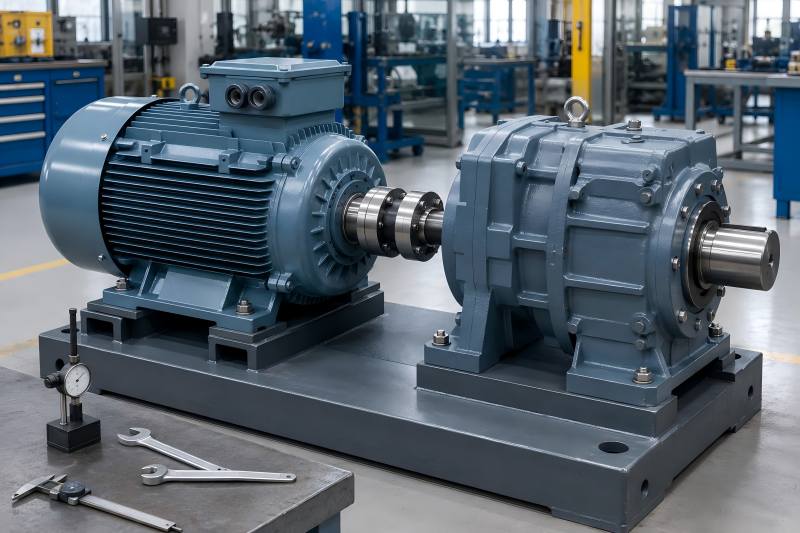
Understand the Required Output Speed
The first step is to know the speed required by your driven machine. A synchronous motor speed depends on frequency and pole count. The gearbox reduces this motor speed to the working speed needed by the equipment.
Basic Formula
Gear ratio = Motor speed ÷ Required output speed
For example, if your synchronous motor runs at 1500 rpm and your machine needs 100 rpm:
Gear ratio = 1500 ÷ 100 = 15:1
This means you need a gearbox with a reduction ratio close to 15:1.
Common Motor Speed and Gear Ratio Examples
| Motor Speed | Required Output Speed | Approx. Gear Ratio | Typical Application |
| 3000 rpm | 300 rpm | 10:1 | Small automation equipment |
| 1500 rpm | 150 rpm | 10:1 | Conveyor drive system |
| 1500 rpm | 100 rpm | 15:1 | Mixer or feeder |
| 1000 rpm | 50 rpm | 20:1 | Heavy-duty conveyor |
| 750 rpm | 30 rpm | 25:1 | Rotary table or slow drive |
Calculate the Required Output Torque
Torque is critical when pairing a synchronous motor with a gearbox. The gearbox reduces speed but increases torque. This allows a smaller high-speed motor to drive a lower-speed, higher-torque load.
Basic Torque Formula
Torque = 9550 × Power ÷ Speed
Where:
- Torque is in N·m
- Power is in kW
- Speed is in rpm
For example, if the motor power is 5.5 kW and the gearbox output speed is 100 rpm:
Torque = 9550 × 5.5 ÷ 100 = 525.25 N·m
This means the gearbox output torque should be higher than 525 N·m after considering efficiency and safety factor.
Choose the Correct Motor Power
The synchronous motor power should match the load demand. If the motor power is too low, the motor may fail to start, run with high current, lose synchronism, or overheat. If the motor power is too high, the system cost increases and energy efficiency may become poor under light load.
When selecting motor power, check:
- Starting torque requirement
- Continuous running torque
- Peak load torque
- Load inertia
- Working hours per day
- Number of starts and stops
- Shock load level
- Ambient temperature
- Cooling condition
For stable loads, such as fans or pumps, the required power is usually easier to calculate. For shock loads, such as crushers, mixers, presses, or heavy conveyors, you need a higher safety margin.
Select the Right Gearbox Ratio
Once motor and output speeds are clear, choose the gearbox ratio. However, the exact standard gearbox ratio may not match your calculation perfectly. In that case, choose the closest standard ratio and check whether the final output speed is acceptable.
Example
Motor speed: 1500 rpm
Required output speed: 120 rpm
Required ratio = 1500 ÷ 120 = 12.5:1
If standard gearbox ratios are 10:1, 12:1, 15:1, and 20:1, a 12:1 ratio may be more suitable if the machine can accept a slightly higher output speed.
Check Gearbox Output Torque Capacity
Do not only check the gear ratio. You must also check whether the gearbox can handle the required torque. A gearbox with the correct ratio but insufficient torque rating may fail quickly.
You should compare:
- Required load torque
- Gearbox rated output torque
- Peak torque capacity
- Service factor
- Overload capacity
- Thermal rating
For heavy-duty use, the gearbox rated torque should be higher than the calculated torque after applying a service factor.
Consider the Service Factor
The service factor is a safety multiplier used to protect the gearbox from real working conditions. A machine that runs smoothly for 8 hours per day needs a lower service factor than a machine that works 24 hours per day with shock loads.
Suggested Service Factor Reference
| Working Condition | Load Type | Working Time | Suggested Service Factor |
| Light duty | Smooth load | Less than 8 hours/day | 1.0–1.2 |
| Medium duty | Moderate load | 8–16 hours/day | 1.2–1.5 |
| Heavy duty | Shock load | 16–24 hours/day | 1.5–2.0 |
| Severe duty | Frequent impact | Continuous operation | 2.0+ |
For example, if your calculated torque is 500 N·m and the service factor is 1.5:
Required gearbox torque = 500 × 1.5 = 750 N·m
So you should select a gearbox rated for at least 750 N·m.
Match the Motor Starting Characteristics
Synchronous motors have different starting requirements compared with standard induction motors. Some synchronous motors use damper windings, VFD control, soft starters, or special starting systems. When matching a gearbox, you must make sure the gearbox and driven load do not create excessive starting resistance.
Check these points:
- Can the motor start the load through the gearbox?
- Is the load too heavy during startup?
- Is the load inertia too high?
- Does the motor need unloaded starting?
- Is a clutch or soft start system needed?
- Will the gearbox experience high shock during starting?
For high-inertia loads, the motor may need a longer acceleration time or a different starting method.
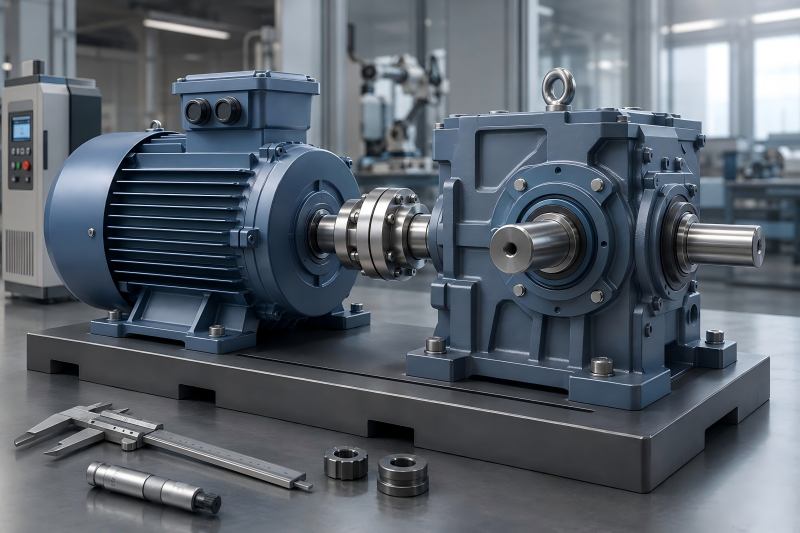
Check Load Type and Application
Different applications require different gearbox types. A conveyor may use a helical gearbox or shaft-mounted gearbox. A precision automation system may require a planetary gearbox. A lifting system may need a worm gearbox or brake motor design. A mixer may require a heavy-duty helical bevel gearbox.
Common Gearbox Options
- Helical gearbox: High efficiency, smooth running, suitable for conveyors and general machinery.
- Planetary gearbox: Compact design, high torque density, good for automation and precision control.
- Worm gearbox: large reduction ratio, compact structure, suitable for slow-speed applications.
- Bevel gearbox: Suitable for right-angle transmission.
- Helical bevel gearbox: Strong, efficient, and suitable for heavy-duty industrial use.
Check Shaft, Coupling, and Mounting Compatibility
Mechanical compatibility is very important. Even if the motor and gearbox ratings are correct, poor shaft matching or bad alignment can cause vibration, bearing damage, and coupling failure.
You should check:
- Motor shaft diameter
- Gearbox input shaft size
- Keyway size
- Coupling type
- Mounting position
- Flange size
- Base height
- Shaft centerline height
- Rotation direction
- Space for installation and maintenance
For direct connection, the motor flange and gearbox input flange must match. For coupling connection, shaft alignment must be accurate.
Consider Gearbox Efficiency
Gearboxes lose some energy during transmission. Helical and planetary gearboxes usually have higher efficiency, while worm gearboxes may have lower efficiency, especially at high reduction ratios.
If your system runs many hours per day, gearbox efficiency becomes very important. A more efficient gearbox can reduce energy costs, heat generation, and long-term operating expenses.
Approximate Efficiency Range
| Gearbox Type | Typical Efficiency | Main Advantage |
| Helical gearbox | 90%–96% | Efficient, smooth performance |
| Planetary gearbox | 90%–97% | Compact, high-torque design |
| Helical bevel gearbox | 88%–95% | Strong right-angle transmission |
| Worm gearbox | 50%–90% | Large ratio and compact structure |
Check Backlash Requirements
Backlash means the small clearance between gear teeth. For simple conveyors or mixers, small backlash may not be a big problem. But for positioning systems, robotics, CNC equipment, indexing tables, and automation machines, backlash control is very important.
For precise positioning, use a low-backlash gearbox like a precision planetary gearbox.
Match the Gearbox with the Working Environment
The operating environment affects gearbox life. Dust, moisture, chemicals, high temperature, low temperature, and outdoor use can all influence gearbox selection.
For harsh environments, consider:
- Higher IP protection
- Better shaft seals
- Anti-corrosion coating
- Food-grade lubrication if required
- High-temperature grease or oil
- Explosion-proof motor design if needed
- Stronger housing material
For outdoor equipment, sealing and corrosion resistance are especially important.
Review Lubrication and Maintenance
Gearboxes need proper lubrication to minimize friction and wear. Before final selection, check the lubrication method and maintenance requirements.
Important points include:
- Oil type
- Oil change interval
- Grease requirements
- Mounting position
- Breather plug position
- Oil level inspection
- Seal replacement
- Operating temperature
Wrong mounting position can cause poor lubrication, oil leakage, and gear failure.
Avoid Common Matching Mistakes
Many motor and gearbox failures happen because the selection only considers power and speed, while ignoring real working conditions.
Common mistakes include:
- Choosing only by motor power
- Ignoring service factor
- Selecting the wrong gear ratio
- Using a gearbox with insufficient output torque
- Ignoring shock load
- Ignoring starting torque
- Poor shaft alignment
- Wrong mounting position
- Ignoring gearbox efficiency
- Selecting low-backlash gearbox only after problems occur
Step-by-Step Selection Process
You can follow this process when matching a synchronous motor with a gearbox:
- Confirm the required output speed.
- Confirm the required output torque.
- Select the synchronous motor power and speed.
- Calculate the gearbox ratio.
- Choose the gearbox type.
- Check gearbox rated torque.
- Apply the service factor.
- Check starting torque and load inertia.
- Confirm shaft, flange, and mounting dimensions.
- Check efficiency, backlash, and environmental protection.
- Review lubrication and maintenance requirements.
- Test the system under real load conditions.
Matching a synchronous motor with a gearbox requires careful calculation and practical application review. You need to consider output speed, torque, motor power, gear ratio, service factor, load type, starting condition, mounting design, efficiency, and working environment. A well-matched system can provide stable speed, reliable torque transmission, lower energy loss, and longer service life. Before final selection, always check both the motor data and gearbox rating, and make sure the complete drive system can handle real operating conditions, not just theoretical calculations.