
A permanent magnet synchronous motor acceptance test should prove that the supplied motor and agreed drive arrangement meet the project’s operating requirements under documented conditions. The plan needs defined test points, measurement methods, acceptance limits, and responsibilities before testing begins. Factory testing and site testing then provide complementary evidence rather than duplicate certificates with unclear purposes.
Which Requirements Should the Test Plan Start With?
Start with the machine duty and the purchase agreement, not a generic list of measurements. Identify the required speed and torque range, continuous operating conditions, temporary demands, and environmental assumptions. For each proposed check, identify the machine requirement it will verify and explain what an acceptable result would establish for the buyer.
When evaluating a model from the Leili PMSM product range, distinguish published family information from the specific performance agreed for that model. Record the exact motor identification and any agreed configuration differences. A report for another winding, cooling arrangement, or drive setup may provide background without proving compliance for the delivered unit.
Separate routine manufacturing checks from project-specific performance verification. The former may demonstrate production quality against the manufacturer’s procedures, while the latter addresses a particular operating requirement. Ask which tests apply to every supplied unit and which apply only to a representative design or an agreed sample.
How Should Test Points Be Chosen?
Choose points that represent the operating envelope and the project’s important risks. A rated point may be necessary, but a machine spending most of its time at reduced output also needs relevant evidence there. Starting or temporary overload requirements should be described by both magnitude and duration.
Avoid expanding the plan into a large grid of measurements without a clear purpose. More readings do not automatically provide better coverage if they repeat easy conditions and omit a demanding operating state. A compact plan with justified test points is usually easier to witness, interpret, and repeat.
| Test Point | Purpose | Conditions to Record |
| Rated operation | Check the agreed rating | Load, speed, cooling, supply |
| Normal process duty | Represent expected service | Actual duty assumptions |
| Reduced-speed duty | Check usable operating range | Torque and thermal condition |
| Temporary demand | Verify permitted transient duty | Duration and recovery |
| Routine transition | Observe system response | Command and load sequence |
Agree what happens when a test point cannot be reproduced at the factory. A site test, a separate engineering assessment, or an explicitly limited acceptance statement may be appropriate. The missing condition should remain visible in the record rather than disappearing behind a general pass label.
What Makes Measurement Evidence Credible?
The report should define each measured quantity, the instrument used, its calibration status, and the measurement method. For electrical performance, identify whether the boundary is at the inverter input, motor terminals, or another location. Mechanical output requires a compatible torque and speed measurement method where it is part of the acceptance claim.
Under NIST’s explanation of metrological traceability, the measured result must be connected to its reference through a documented sequence of calibrations. The evaluator must still decide whether the assembled measurement method can answer the purchasing question; an instrument’s calibration certificate does not settle that judgement. The project should also consider uncertainty, installation, range, and the way readings are combined.
Specify how stable operating conditions must be before readings are accepted. Temperature, load, and speed should be recorded with sufficient context to distinguish a settled measurement from a transient observation. If averaging is used, state its duration and preserve information about meaningful fluctuations.

How Should Efficiency Claims Be Tested?
An efficiency claim requires clearly defined input and output quantities measured under comparable conditions. Motor efficiency and complete drive-system efficiency describe different boundaries. A report should not present one as the other simply because the motor is the main item being purchased.
Agree the applicable test method and uncertainty treatment with the supplier before setting a narrow acceptance threshold. Small differences between measured and quoted efficiency can be difficult to interpret when the measurement uncertainty is not stated. The purchasing decision should use an agreed decision rule rather than an improvised judgement after the test.
If the project concerns annual energy use, several relevant duty points may be more informative than the highest measured efficiency. Weighting those points by operating hours belongs in a separate energy model. Keep the measured results distinct from the assumptions used to turn them into an annual estimate.
Which Thermal Conditions Need to Be Documented?
Document ambient conditions, cooling arrangement, initial state, operating duration, and the available temperature measurements. A short run from cold cannot by itself demonstrate a continuous-duty thermal claim. The supplier should define the relevant stabilization or duty-cycle criterion and the limits that apply to the selected model.
Protective sensors also need functional verification within an approved procedure. Confirm that the expected signal reaches the drive or machine controller and produces the agreed response. This is different from merely checking that a temperature value appears on a screen.
Leili’s article on PMSM overheating and engineering responses gives useful context for the thermal review. The acceptance document should nevertheless use the actual motor’s approved limits, not generalized temperature figures from an explanatory article. Record any reduced rating required by the test or installation conditions.
What Mechanical Observations Belong in the Record?
Record the mounting arrangement, coupling, alignment basis, and relevant vibration or noise observations. These conditions help explain the result and support comparison with later site measurements. A factory test stand and the final machine foundation can behave differently, so neither result should be interpreted without its installation context.
Use agreed measurement locations and operating conditions when vibration forms part of acceptance. Changing sensor location or load can make readings difficult to compare. Photographs or a simple location diagram can be useful supporting records without turning an observation into a universal diagnosis.
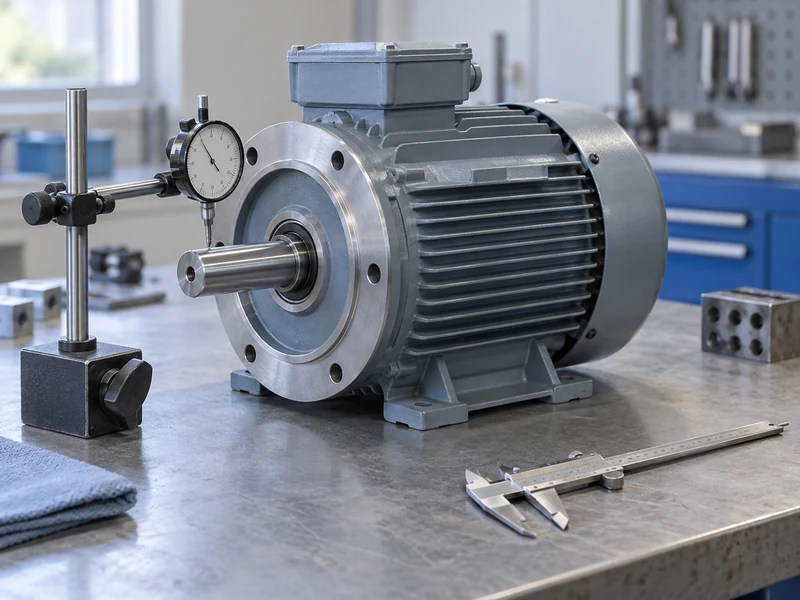
The related guide to PMSM bearing noise and vibration problems can help organize possible follow-up investigations. An unexpected symptom should trigger a documented investigation rather than an immediate assumption that the motor itself is defective. Preserve the original observations before changing alignment, control settings, or other relevant conditions.
How Should Factory and Site Tests Be Divided?
Use factory testing for checks best performed on the manufacturer’s equipment and site testing for requirements that depend on the installed machine. The factory may provide controlled loading and dedicated instruments, while the site reveals actual supply conditions, cooling integration, process behavior, and support structure. The two stages should share enough information to explain differences.
For a drive-fed system, record the inverter model, software version, and approved parameter set used during each stage. Leili’s overview of PMSM control strategies provides background, but the report needs the actual configuration. A factory result obtained with one control arrangement should not silently be treated as proof for a different site arrangement.
Projects within Leili’s industrial applications may have different priorities depending on the driven equipment. A pump project might emphasize stable hydraulic service, while another machine places greater importance on acceleration or speed regulation. The site acceptance plan should reflect that specific purpose.
What Should Happen When a Result Falls Outside the Agreement?
When a requirement is missed, preserve the readings and the setup used to obtain them so that the investigation starts from the observed event. Determine whether the issue concerns the supplied equipment, the test setup, the operating requirement, or an unresolved assumption. Retesting should have a defined purpose and preserve the relationship to the original result.
The final acceptance record should identify passed requirements, approved exceptions, unresolved items, and the person responsible for each follow-up. Keep the motor and drive configuration with the signed test record, giving future reviewers a concrete reference when equipment or settings are changed. A signature is most useful when it refers to a clear technical record rather than a broad statement that the motor ran successfully.
Keep this package with the asset documentation after delivery. It gives maintenance and engineering teams a reference when performance changes, a replacement is proposed, or the process duty expands. Acceptance testing then becomes a practical foundation for operating the equipment, as well as a purchasing milestone.