
Outrunner and inrunner BLDC motors are both efficient and reliable brushless motor solutions, but they are designed for different needs.
An outrunner BLDC motor has an external rotating shell and delivers higher torque at lower speed. It is widely used in drones, fans, gimbals, e-bikes, and direct-drive systems.
An inrunner BLDC motor has an internal rotor and is better suited for high-speed operation, better heat dissipation, and compact industrial designs. It is commonly used in power tools, pumps, compressors, spindles, and automation equipment.
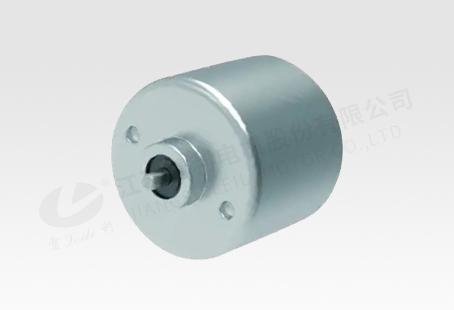
What Is an Inrunner BLDC Motor?
An inrunner BLDC motor has a rotor located inside the stator. The inner magnet rotor spins as surrounding stator windings create a rotating magnetic field.
This design resembles conventional motor layouts, and its compact, lightweight rotor allows inrunner motors to achieve much higher rotational speeds.
Inrunner BLDC motors are commonly used in applications that need:
- High rotational speed
- Compact motor size
- Good heat dissipation
- Precise speed control
- Gearbox or transmission matching
| Pros | Cons |
| High-speed capability | Lower direct torque |
| Better heat dissipation | Often needs gearbox for high torque |
| Compact cylindrical design | Gearbox may increase noise and cost |
| Fast dynamic response | Less suitable for direct-drive propellers |
| Good for continuous operation | Higher RPM may require careful balancing |
Typical applications include electric tools, pumps, compressors, CNC spindles, model boats, industrial automation, and some electric vehicle systems.
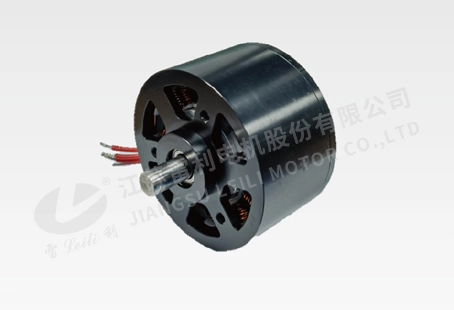
What Is an Outrunner BLDC Motor?
An outrunner BLDC motor has a rotor located outside the stator. The central stator remains stationary, while the outer magnet-mounted casing rotates around it.
With a wider rotating shell, an outrunner delivers stronger low-speed torque, making it ideal for direct-drive systems.
Outrunner BLDC motors are commonly used in:
- Drones and UAVs
- RC aircraft
- Electric bicycles
- Cooling fans
- Direct-drive systems
- Gimbals
- Robotics joints
- Low-speed high-torque applications
| Pros | Cons |
| High torque at low speed | Lower maximum speed |
| Good torque-to-weight ratio | Cooling can be more difficult |
| Suitable for direct drive | Larger rotating outer shell |
| Often no gearbox needed | Higher rotational inertia |
| Ideal for drones, fans, and e-bikes | Not ideal for very high-speed systems |
The main feature of an outrunner motor is its strong torque output without always needing a gearbox.
Basic Structural Difference
The biggest difference between an outrunner and an inrunner BLDC motor is the position of the rotor.
| Item | Inrunner BLDC Motor | Outrunner BLDC Motor |
| Rotor position | Inside the stator | Outside the stator |
| Stator position | Outside | Inside |
| Rotating part | Inner shaft/rotor | Outer shell/can |
| Speed | Higher | Lower |
| Torque | Lower at same size | Higher at same size |
| Cooling | Usually better | More challenging |
| Common use | High-speed systems | Direct-drive torque systems |
In simple terms, an inrunner is better for speed, while an outrunner is better for torque.
Torque Comparison
An outrunner BLDC motor usually produces more torque than an inrunner motor of similar size because its rotor has a larger diameter. A larger rotor radius gives the motor greater leverage, allowing it to generate stronger turning force.
This is why outrunner motors are widely used in drones. Drone propellers need strong torque at relatively low speed, and an outrunner motor can drive the propeller directly without a gearbox.
Inrunner motors usually deliver less direct torque. If high torque is needed, they are often paired with a gearbox. The gearbox reduces speed and increases torque.
Speed Comparison
Inrunner BLDC motors are usually better for high-speed operation. Since the rotor is smaller and lighter, it has lower rotational inertia. It enables quicker acceleration and speed adjustment.
Outrunner motors usually run at lower speeds because the outer rotating shell is larger and heavier. At very high speed, the larger rotating mass can create more mechanical stress.
For this reason, inrunner motors are often used in high-speed tools, pumps, spindles, and compressors. Outrunner motors are more common in low-speed or medium-speed applications where torque is more important than maximum RPM.
Efficiency Comparison
Both outrunner and inrunner BLDC motors can be highly efficient when properly designed and matched with the right controller.
However, efficiency depends on many factors, including:
- Motor size
- Winding design
- Magnet quality
- Controller performance
- Load condition
- Cooling method
- Operating speed
Outrunner motors can be very efficient in direct-drive applications because they may not need a gearbox. Removing the gearbox reduces mechanical losses, noise, and maintenance.
Inrunner motors can also be highly efficient, especially at high speeds. But when a gearbox is required, total system efficiency may be affected by gear friction and transmission loss.
Heat Dissipation
In an inrunner BLDC motor, the stator windings are located near the outer housing. Since most motor heat is generated in the windings, this structure helps transfer heat to the motor case more easily. As a result, inrunner motors usually have better cooling performance.
The stator sits inside the rotating outer casing. The heat source is more enclosed, which can make cooling more difficult. Some outrunner motors rely on airflow from rotation, ventilation holes, or external cooling design to control temperature.
For continuous heavy-duty operation, cooling should be carefully considered, especially when using an outrunner motor.
Size and Weight
Outrunner motors often provide high torque in a compact axial length. Their short and wide structure makes them suitable for applications where strong torque is needed but motor length is limited.
Inrunner motors are often longer and narrower. They are suitable for compact cylindrical spaces and high-speed systems.
For drones, outrunner motors are popular because they offer excellent torque-to-weight ratio. For electric tools and pumps, inrunner motors are often preferred because their shape fits better inside narrow housings.
Control and Response
Both motor types require an electronic speed controller, also known as an ESC or BLDC driver.
Inrunner motors generally have lower rotor inertia, so they can respond quickly to speed changes. They are ideal for precise high-speed control.
Outrunner motors have higher inertia because the outer shell rotates. This can make acceleration and deceleration slower compared with inrunner motors. However, the higher inertia can also provide smoother rotation in some applications.
For precision applications, the final performance depends not only on motor type, but also on the encoder, controller algorithm, load condition, and mechanical design.
Noise and Vibration
Outrunner motors can run smoothly at lower speeds because of their higher torque and larger rotating mass. This can be useful for fans, gimbals, and direct-drive systems.
Inrunner motors may produce more noise when running at very high speed, especially if they are paired with gears. However, a well-balanced inrunner motor can still operate quietly.
Noise and vibration are also affected by bearing quality, motor balance, controller switching frequency, and installation structure.
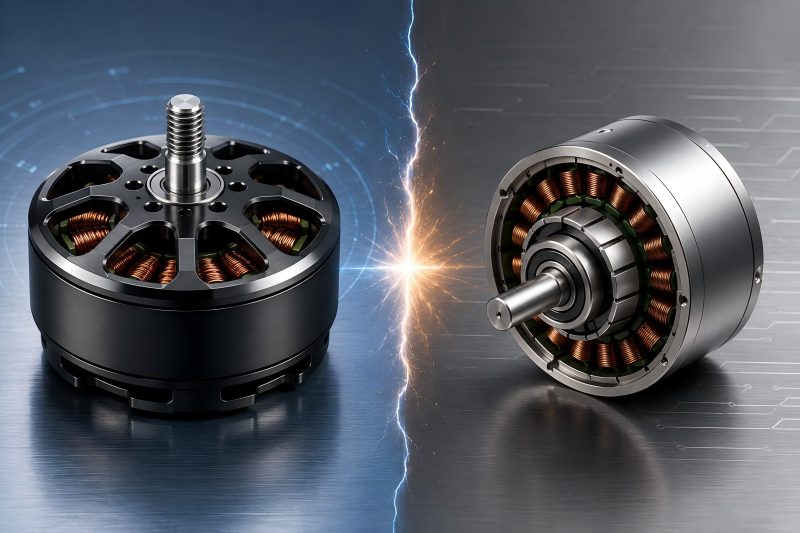
Application Comparison
| Application | Better Choice | Reason |
| Drone propeller | Outrunner | High torque, direct drive, lightweight |
| Electric drill | Inrunner | High speed, compact body, gearbox compatible |
| Cooling fan | Outrunner | Good low-speed torque and direct drive |
| Pump | Inrunner | High speed and better cooling |
| CNC spindle | Inrunner | Very high RPM requirement |
| Gimbal | Outrunner | Smooth low-speed torque |
| Electric bicycle hub motor | Outrunner | Direct wheel drive and high torque |
| Compressor | Inrunner | Continuous high-speed operation |
| Robot joint | Outrunner or geared inrunner | Depends on torque and space |
| RC boat | Inrunner | High RPM and compact design |
How to Select the Right BLDC Motor Type
When choosing between an outrunner and an inrunner BLDC motor, consider the following factors.
Required Speed
If your application requires very high RPM, an inrunner motor is usually the better choice. Built for high speed and compatible with gear reduction.
If your application runs at low or medium speed, an outrunner motor may be more suitable.
Required Torque
If you need high torque without a gearbox, choose an outrunner motor. Its larger rotor diameter helps generate strong torque directly.
If torque can be increased through a gearbox, an inrunner motor may also be a good option.
Space Limitation
If the motor needs to fit into a long and narrow space, an inrunner motor is often easier to install.
If the application allows a wider motor with shorter length, an outrunner motor can provide strong torque in a compact package.
Cooling Requirement
For continuous heavy-duty operation, inrunner motors usually have an advantage because their winding heat can be transferred to the outer housing more easily. Ensure proper airflow and cooling to prevent overheating.
Direct Drive or Gear Drive
If you want a simple direct-drive system, an outrunner motor is often better. It can reduce the need for gears, belts, or transmission parts.
If your system already uses a gearbox or needs very high speed before reduction, an inrunner motor may be more suitable.
Cost and Maintenance
Outrunner motors can reduce system complexity because they may not need a gearbox. This can lower maintenance in some applications.
Inrunner motors may require additional transmission parts, but they are often easier to cool and protect in industrial environments.
Which Is Better?
There is no single answer. Outrunner BLDC motors are better for high-torque, low-speed, direct-drive applications. Inrunner BLDC motors are better for high-speed, compact, and continuous-duty applications.
Choose an outrunner motor if your application needs strong torque, low speed, lightweight design, and direct drive. Choose an inrunner motor if your application needs high RPM, better cooling, compact cylindrical structure, or gearbox integration.